Modelling the
human,
not the text.
We build the Large Behavioural Model (LBM) — the world's only foundational AI architecture that treats human behaviour as a first-class computational primitive.
| Modality | Input | Architecture | Status |
|---|---|---|---|
| Language | Tokens | GPTClaudeLLaMA | ✓ Solved |
| Vision | Pixels | ViTsCLIPDINOv2 | ✓ Solved |
| Physical World | Actions / Physics | JEPAGenie | ◐ Emerging |
| Audio | Spectrograms | WhisperAudioPaLM | ✓ Solved |
| Human Behaviour | Behavioural State Vectors | LBM | ◉ We're building it |




Correlation Is Not Enough: Embedding Human Metadata for Individual Causal Discovery
This paper argues that correlation alone is too thin to support serious human modeling, because it collapses individual structure into population averages. It proposes embedding human metadata to recover person-level causal organization, enabling more grounded inference, personalization, and state estimation.

You Are in Control of Your State: Why Human Outcomes Are Controllable Through Causal State Intervention
This paper argues that human outcomes are mediated by dynamic latent state at the moment of decision, not by observable inputs alone. It proposes a causal state-intervention framework that combines attentional bottlenecks, longitudinal behavior, and state weighting to define practical levers for change.

Is It You or Your Environment? A Bayesian Inference Framework for Genomically-Anchored Personalized Physiological Interpretation
This paper proposes a Bayesian framework that uses genomic priors as a personalized anchor for physiological interpretation. It separates constitutional baseline from environment-driven deviation, allowing earlier and more individualized interpretation of physiological signals.

Human Modelling Requires a Causal Architecture of Behaviour and Biology, Not Correlation
This paper argues that human modeling must be built on causal architecture rather than correlation-only representations. It frames behavior and biology as interacting regimes, which makes inference more structurally valid and more useful for intervention design.

Expert review: You Are in Control of Your State
This review validates the central claim that human outcomes are not fixed outputs but controllable trajectories shaped through causal intervention. It serves as external commentary supporting the state-based framing and strengthening the broader research program.
Dotsin GitHub
Our GitHub organization publishes the reproducible layers of the research stack, including code, model artifacts, benchmark tooling, and validation utilities. It functions as the public engineering surface of the lab, supporting transparency, reproducibility, and iterative development.
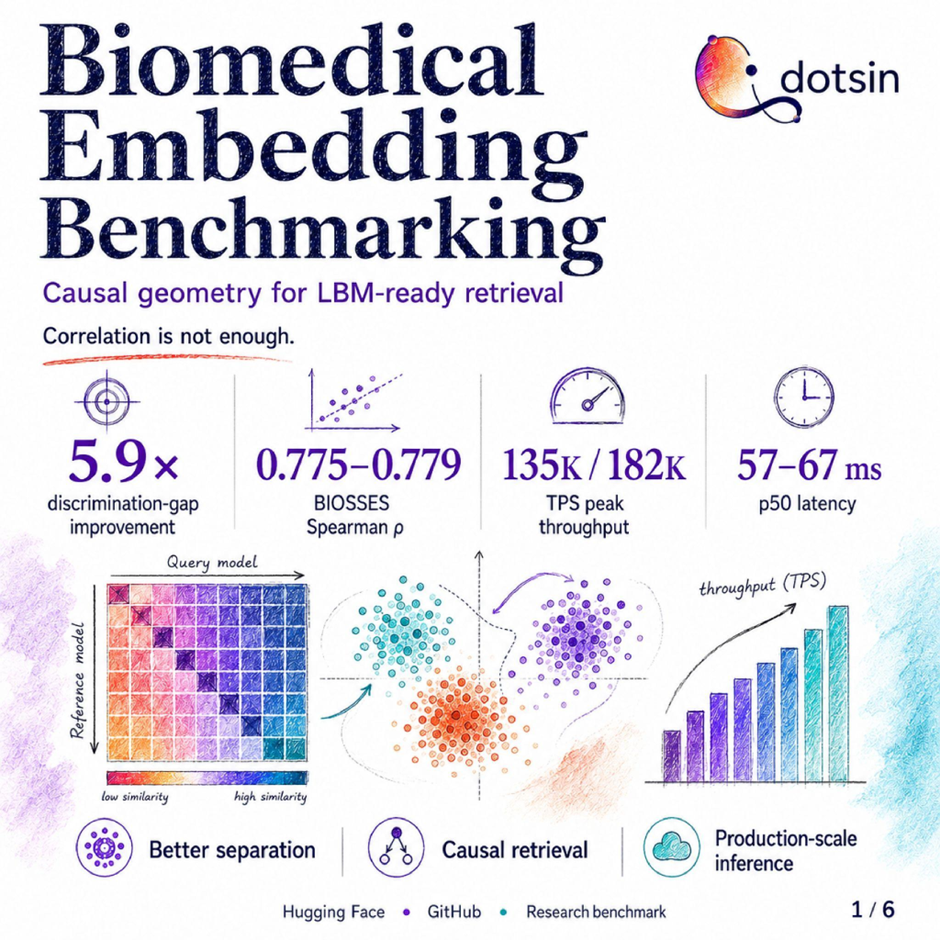
Benchmark repo ~ Biomedical BERT Embedding Quality & Inference Benchmark
This benchmark demonstrates whether biomedical embeddings preserve meaningful semantic structure while remaining efficient enough for production inference. It evaluates similarity quality, hard-negative separation, and operational performance under realistic hardware constraints.

Hugging Face model
This model release exposes the retrieval layer of the biomedical inference stack as a controlled, production-oriented embedding model. It is designed to index text by semantic and causal proximity, making it a reusable foundation for downstream research workflows.
Intel Partnership
We’re now an official Intel AI Partner, optimizing LBM inference on Xeon 6 with OpenVINO and IPEX for real-time behavioural intelligence at scale.
NVIDIA Partnership
Accepted into NVIDIA’s Inception Program, we’re building the behavioural AI infrastructure that makes human understanding as foundational as language intelligence.
The room is open.
We're building the first Behavioural Foundation Model from India — not as a company project, but as a national scientific effort.
Join the community →